

RemodelerIQ vs. Renovation Cost Calculators: The Data Showdown
Why live, localized market intelligence beats static formulas for your remodel budget.
Accuracy in a remodeling estimate isn’t just a nice-to-have; it’s the bedrock of a successful project. With 80% of mortgaged homeowners locked into sub-5% rates, the “improve-in-place era” means more complex renovations, not just simple fixes. Getting cost estimates right, especially now, is more critical than ever to avoid budget overruns and contractor disputes. But which tool provides the real numbers you need: a quick online calculator or a dynamic data platform?
If you’re choosing between a generic online cost calculator and a live data platform like RemodelerIQ, opt for the latter. While calculators offer a quick, rough estimate, they lack the regional, real-time data and contract risk analysis crucial for today’s complex renovations. RemodelerIQ delivers up-to-the-minute labor, material, and Zonda cost data, paired with critical contract and scope vetting that calculators completely miss.

The Verdict: Why Live Data Is Non-Negotiable
When you’re planning a major home renovation, guessing isn’t an option. The honest truth is, the gap between a generic online cost calculator and a sophisticated, data-driven platform like RemodelerIQ isn’t just about accuracy; it’s about protection. Most homeowners don’t realize how much these tools differ until they’re deep into a project and realize their budget is off by tens of thousands, or worse, they’re facing an expensive change order they never saw coming.
The Basic Calculator: A Starting Point, Not a Solution
When a Calculator Helps
- Getting a very rough, early budget idea (e.g., ‘Can I even afford a kitchen remodel?’).
- Quickly comparing vastly different project types (e.g., ‘Is a new deck cheaper than a bathroom reno?’).
- Exploring very high-level cost ranges for different cities, without needing precise data.
Where Calculators Fall Short
- Providing real-time, localized labor and material costs.
- Identifying hidden fees, vague allowances, or unfair payment terms in a contractor’s bid.
- Comparing the specifics of multiple contractor estimates line-by-line.
- Detecting missing scope items or potential change orders before work begins.

43%
Homeowners who use online calculators underestimate project costs by 43% on average.
Source: Houzz & Home Study 2024 (2024)
Relying on National Averages for Local Work
A national average for labor or materials can be off by 20-30% for your specific city. For example, a journeyman electrician in Atlanta earns $30.82/hour (BLS OEWS 2026), but in San Francisco, that jumps to $51.04/hour. Using a national average risks serious misbudgeting.
Most homeowners don’t know that their zip code can swing labor costs by 30% or more.
RemodelerIQ: Your Personal Project Safeguard
Here’s what I’d do if this were my house: I’d treat my remodeling project like a serious investment. That means getting beyond surface-level numbers. RemodelerIQ isn’t just about giving you a cost; it’s about giving you leverage. We take your actual contractor bids and put them through a rigorous 100-point audit, breaking down everything from labor rates (using BLS OEWS 2026 data for your specific metro) to material pricing (using FRED PPI Q1 2026 indices) to overall project value (Zonda 2026 Cost-vs-Value report).
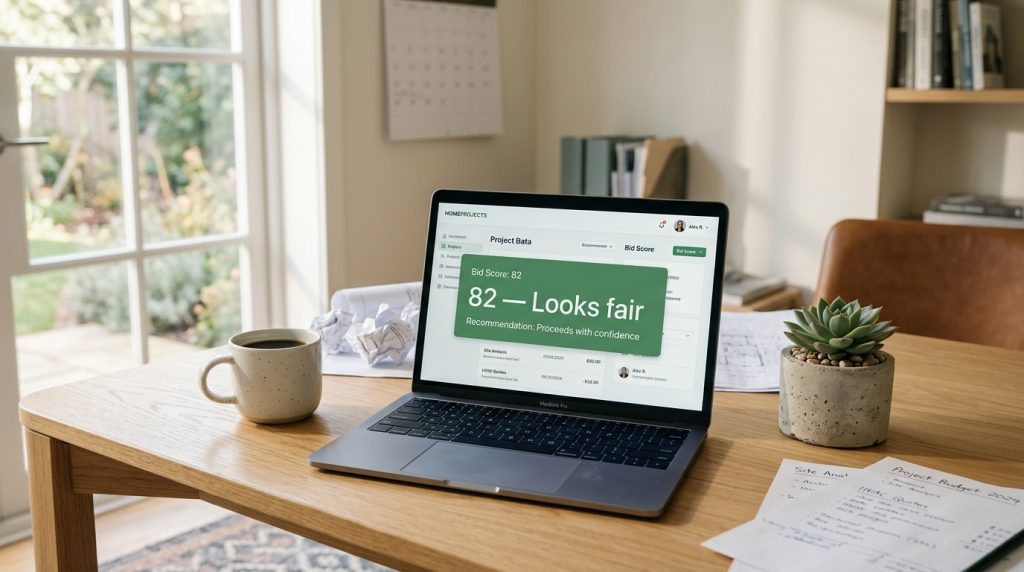
Our analysis generates a Confidence Score (0-100) across three critical pillars: Contract Risk (40%), Price Check (30%), and Scope Completeness (30%). A low score in Contract Risk, for instance, means we’ve flagged clauses that could cost you thousands down the line, like a vague payment schedule or unitemized allowances. This isn’t just about what you pay, but what you actually get for your money and what you’re legally binding yourself to. Every section ends with what to ask your contractor.
Before you sign, always upload your bid to remodeleriq.com. The red flag alerts and specific questions we provide can literally save your project and your budget from common contractor traps. This is negotiable — and RemodelerIQ shows you how.
Frequently Asked Questions
Are online cost calculators ever accurate?
Generic online cost calculators offer broad, national average estimates that can be wildly inaccurate for your specific location and project details. They are best used for a very preliminary, high-level budget idea, not for making financial decisions or evaluating contractor bids.
How does RemodelerIQ get its data?
RemodelerIQ aggregates live, localized data from authoritative sources: BLS Occupational Employment Statistics (OEWS 2026) for labor wages, FRED Producer Price Index (Q1 2026) for material costs, Zonda’s 2026 Cost-vs-Value report for project benchmarks, and our own proprietary analysis of millions of bids nationwide. This ensures hyper-local and up-to-date figures.
Can RemodelerIQ really detect hidden costs in a contract?
Yes. Our Contract Risk pillar (40% of the Confidence Score) scans for over 200 common contractual pitfalls. This includes vague allowances, unitemized line items, unfair payment schedules, ambiguous scope descriptions, and clauses that shift risk unfairly to the homeowner. We highlight these as red flags in your report.
What is the ‘lock-in effect’ and why does it matter for remodeling costs?
The ‘lock-in effect’ refers to the current market where ~80% of mortgaged homeowners have interest rates below 5%. This makes refinancing for a move financially unattractive. As a result, many homeowners are choosing to renovate and improve their current homes instead of moving, leading to more complex, higher-value remodeling projects. Accurate cost data is crucial to manage these larger investments.
How does RemodelerIQ help me negotiate with contractors?
RemodelerIQ provides a detailed breakdown of fair market costs for labor and materials in your specific area. When your bid is analyzed, we highlight areas where pricing is significantly above market. This gives you concrete, data-backed points to discuss with your contractor, helping you negotiate more effectively and ensure your bid reflects fair value.




Leave a Reply